
Dacryops
Written September 2025
Kyle S. Chan, MD and Liza M. Cohen, MD
Background
- Also known as lacrimal gland cyst or lacrimal ductal cyst
- Epidemiology
- Incidence of 0.5% to 2% (Tanaboonyawat et al.)
- Mean age of 49 years (Shields et al.)
- Etiology
- Typically idiopathic
- Other causes: ocular cicatricial pemphigoid
- Signs/symptoms
- Typically asymptomatic and unilateral
- Mobile and painless swelling
- Transillumination
- Irritation, foreign body sensation
- If severe, can cause proptosis or diplopia
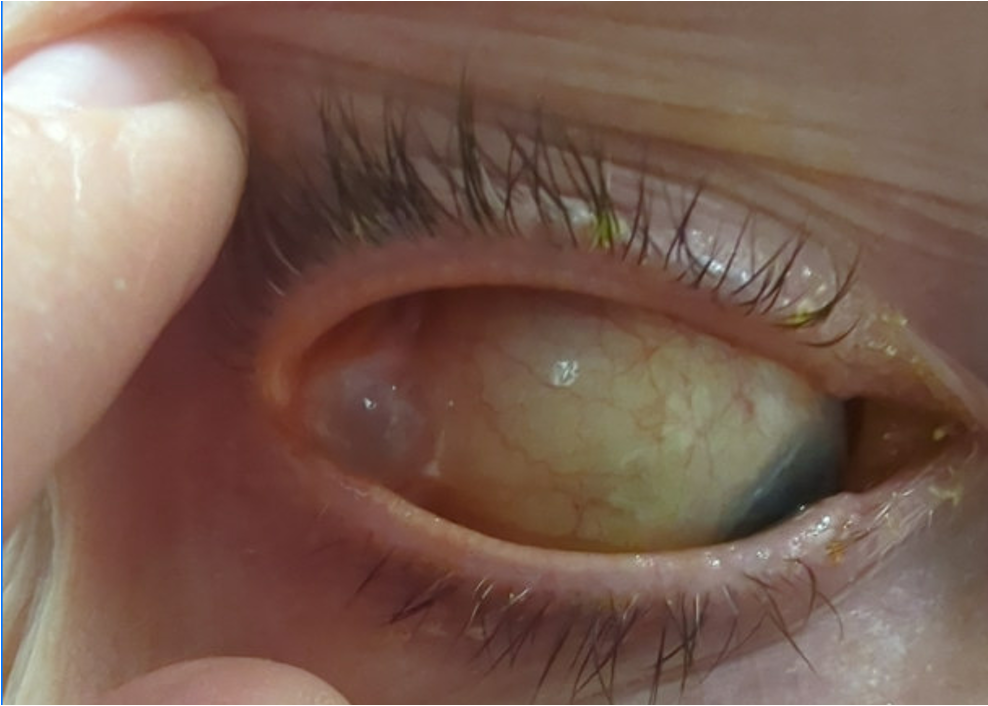
Pathophysiology
- Possible role of IgA expression leading to cyst formation (Weatherhead et al., Lam et al., Tanaboonyawat et al.)
- Fibrosis with chronic inflammatory conditions
- Occlusion of lacrimal ducts previously thought to be implicated (Tanaboonyawat et al.)
Establishing the diagnosis
Classification
- Palpebral lobe cysts
- Most common
- Visible externally on superolateral ocular surface
- Orbital lobe cysts
- Rare
- Located within orbit
- Can present with mass effect symptoms
- Cysts of accessory lacrimal glands of Krause and Wolfring
- Krause gland involvement within fornices
- Wolfring gland involvement along proximal tarsus
- Cysts of ectopic lacrimal glands
- Due to ectopic lacrimal gland tissue sometimes located in caruncle, conjunctiva, etc.
Testing and evaluation
- Clinical diagnosis if visible
- Histopathology – nonkeratinizing epithelial cysts with surrounding fibrous wall
- Ultrasound – hypoechoic lesion with hyperechoic cystic wall
- CT – fluid density cystic lesion without bony erosion/destruction
- MRI – fluid intensity cyst without contrast enhancement
Differential diagnosis
- Palpebral lobe cyst:
- Conjunctival cyst
- Hidrocystoma
- Orbital lobe cyst:
- Dermoid cyst
- Epidermoid cyst
- Dacryoadenitis
- Lymphoma
- Lacrimal gland neoplasms
Patient management: treatment and follow-up
- Conservative management preferred
- Surgical excision if symptomatic
- Marsupialization
- Argon laser photocoagulation – limited evidence
Preventing and managing treatment complications
- Risk of recurrence
- Surgical excision: 2 of 55 patients (Alsarhani et al.)
- Marsupialization: 1 of 3 patients (Smith et al.), 0 of 6 patients (Salam et al.)
- Scarring
- Tear deficiency (theoretical if lacrimal gland tissue damaged)
Disease-related complications
- Infection
- Case series of 5 patients with concern for abscess, 4 were successfully managed with systemic IV or oral antibiotics, no cultures obtained due to patients being pretreated (Kurup et al.)
- Chronic inflammation
References and additional resources
- Alsarhani WK, Al-Sharif EM, Al-Faky YH, Alkatan HM, Maktabi AM, Alsuhaibani AH. Dacryops and clinical diagnostic challenges. Can J Ophthalmol. 2022 Dec;57(6):388-393. doi: 10.1016/j.j cjo.2021.06.014. Epub 2021 Jul 26. PMID: 34324876
- Bullock JD, Fleishman JA, Rosset JS. Lacrimal ductal cysts. Ophthalmology. 1986 Oct;93(10):1355-60. doi: 10.1016/s0161-6420(86)33566-8. PMID: 3785895.
- Jakobiec FA, Zakka FR, Perry LP. The cytologic composition of dacryops: an immunohistochemical investigation of 15 lesions compared to the normal lacrimal gland. Am J Ophthalmol. 2013 Feb;155(2):380-396.e1. doi: 10.1016/j.ajo.2012.07.028. Epub 2012 Oct 28. PMID: 23114708.
- Kurup SP, Lissner GS. Characterization of dacryops infections. Ophthalmic Plast Reconstr Surg. 2015 Jan-Feb;31(1):58-62. doi: 10.1097/IOP.0000000000000198. PMID: 24892277.
- Lam K, Brownstein S, Jordan DR, Jastrzebski A. Dacryops: a series of 5 cases and a proposed pathogenesis. JAMA Ophthalmol. 2013 Jul;131(7):929-32. doi: 10.1001/jamaophthalmol.2013.1885. PMID: 23846204.
- Ozgonul C, Uysal Y, Ayyildiz O, Kucukevcilioglu M. Clinical features and management of dacryops. Orbit. 2018 Aug;37(4):262-265. doi: 10.1080/01676830.2017.1423081. Epub 2018 Jan 4. PMID: 29300516.
- Pantaleoni FB, Spagnolo S, Martini A, Pupparo S, Rosati C, Pescosolido N. Argon laser photocoagulation in the treatment of the palpebral lobe cysts of the lacrimal gland (dacryops). Ophthalmic Surg Lasers. 1997 Aug;28(8):690-2. PMID: 9269004.
- Remulla HD, Rubin PA. Giant dacryops in a patient with ocular cicatricial pemphigoid. Br J Ophthalmol. 1995 Nov;79(11):1052-3. doi: 10.1136/bjo.79.11.1052. PMID: 8534655; PMCID: PMC505329.
- Salam A, Barrett AW, Malhotra R, Olver J. Marsupialization for lacrimal ductular cysts (dacryops): a case series. Ophthalmic Plast Reconstr Surg. 2012 Jan-Feb;28(1):57-62. doi: 10.1097/IOP.0b013e31822ddda7. PMID: 21956544.
- Shields JA, Shields CL, Scartozzi R. Survey of 1264 patients with orbital tumors and simulating lesions: The 2002 Montgomery Lecture, part 1. Ophthalmology. 2004 May;111(5):997-1008. doi: 10.1016/j.ophtha.2003.01.002. PMID: 15121380.
- Smith S, Rootman J. Lacrimal ductal cysts. Presentation and management. Surv Ophthalmol. 1986 Jan-Feb;30(4):245-50. doi: 10.1016/0039-6257(86)90120-7. PMID: 3952646.
- Tanaboonyawat S, Idowu OO, Copperman TS, Vagefi MR, Kersten RC. Dacryops – A review. Orbit. 2020 Apr;39(2):128-134. doi: 10.1080/01676830.2019.1608564. Epub 2019 Sep 12. PMID: 31512543.
- Tsai FF, Mukhopadhyay C, Zeng J, Shinder R. Bilateral marked dacryops following trauma. Orbit. 2012 Dec;31(6):435-7. doi: 10.3109/01676830.2012.711889. Epub 2012 Aug 21. PMID: 22909413.
- Weatherhead RG. Wolfring dacryops. Ophthalmology. 1992 Oct;99(10):1575-81. doi: 10.1016/s0161-6420(92)31764-6. PMID: 1454325.
Financial disclosures
Authors
Kyle Chan, MD: None
Liza M. Cohen, MD: None